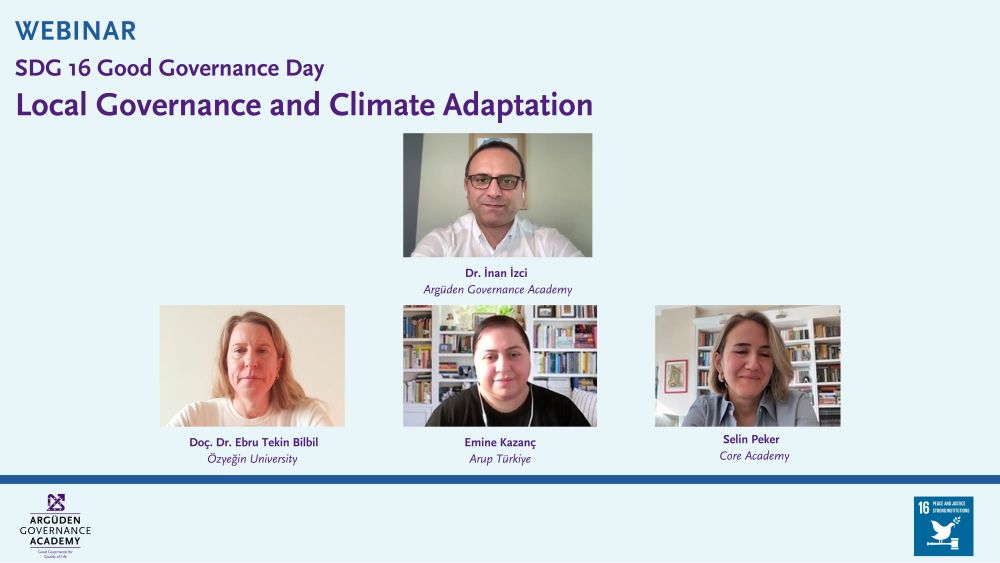
Held between 11:00–12:30 on February 16, the session explored how effective, inclusive, and data-driven governance can accelerate local climate action and highlighted the pivotal role of local governments in building resilient, equitable, and sustainable cities.
Moderated by Dr. İnan İzci, Member of the Academic Board of the Argüden Governance Academy, the webinar convened Associate Professor Dr. Ebru Tekin Bilbil (Urban Politics and Technology Governance, Özyeğin University), Emine Kazanç (Energy and Water Leader, Arup Türkiye), and Selin Peker (Co-Founder, Core Academy)who shared multidimensional perspectives at the intersection of local governance and climate adaptation.
Key Messages
- The climate crisis is a planetary and existential challenge. Delivering measurable and lasting global impact requires action at the city level, where transformation is designed, implemented, and scaled.
- Participatory and inclusive planning processes strengthen social ownership, accelerate implementation, and enhance the sustainability of climate initiatives.
- Governance models grounded in transparency, collective intelligence, and data-driven decision-making are critical to building resilient and future-ready cities.
The discussions reaffirmed that cities are both where climate risks intensify and where solution capacity is strongest. Governance capacity, institutional design, transparency, and accountability therefore emerge as decisive factors in the effectiveness of climate policy.
Perspectives from the Speakers
Dr. İnan İzci emphasized that while the climate crisis is global in scale, cities hold the operational capacity to generate tangible and lasting impact. He underscored that this potential can only be realized through trust-based governance. Transparent, traceable, and accountable processes are not merely principles of good governance—they constitute the foundation of durable climate action. Strong governance enables cities to produce credible, effective, and exemplary outcomes.
Associate Professor Dr. Ebru Tekin Bilbil highlighted the importance of defining climate risks with the same analytical rigor applied to seismic risks—through concrete data and actionable thresholds. Risk assessment alone, she noted, is insufficient; risks must be prioritized, institutionally supported, and systematically integrated into decision-making frameworks. A robust governance architecture enables early detection, strategic resource allocation, and structured stakeholder engagement in climate adaptation.
Emine Kazanç emphasized the decisive role of cities in global emissions, noting that policies in energy, transportation, and waste management present significant opportunities for both mitigation and adaptation. She stressed the importance of smart city solutions, monitoring systems, and long-term strategic planning in strengthening urban resilience, highlighting the need to align infrastructure investments with governance capacity.
Selin Peker underscored that climate adaptation must be rooted in meaningful participation. Engaging stakeholders affected by policy decisions is not only a democratic imperative but also a strategic lever for accelerating implementation and strengthening social ownership. Higher levels of participation directly enhance the sustainability and long-term impact of climate initiatives.
Collective Intelligence and Strategic Transformation
This webinar extended beyond knowledge exchange; it fostered a shared platform for collective responsibility in advancing climate adaptation through stronger local governance. The dialogue demonstrated that effective climate action requires more than technical expertise—it demands institutional integrity and governance excellence.
Transparency, accountability, data-driven decision-making, and participation are not optional components; they are structural prerequisites for credible and lasting climate policy.
Actions taken at the local level today will shape global transformation tomorrow. Cities are not only sites where risks concentrate—they are arenas where solutions are engineered and trust is institutionalized.
With this conviction, we remain committed to strengthening local governance, reinforcing trust, and accelerating sustainable transformation.
Related People